Saturday, October 31, 2015

Managing Media Manipulation

Cartoon credit: Bruce Beattie
Many people are concerned about media bias. That’s a good issue to be aware of, however less often considered but just as important is the influence of media itself.
One important concept that the media and its backers realize, but that many viewers don’t, is the following truth: The media can’t control what you think, but they can control what you think about. In other words, watching television (even biased television) probably won’t change your views. That’s good news to people who think the airwaves are being corrupted by conservative propaganda from FOX news, or liberal propaganda from CNN/MSNBC. The presence or lack thereof of such stations is doing little to change the political leaning of the country. However, what media does tend to affect are the discussions people have around the water cooler at work or around the dinner table at home, what people forward in e-mail or share on Facebook, and so on. For example, a news story about a terrorist attack will stir up many people and get them emotionally demanding change in one way or another. They may say we should increase security, or they may say we should engage traditional enemies and stop our own abuses, but either way they’ll be talking and sharing their (usually very strong) opinions on the matter.
Similar to the above is how both scripted and reality television shows attract viewers: They create and showcase controversy. For example, consider the recently cancelled reality show “Meet the Duggars”, about a fundamentalist Christian family with 19 children. The producers of the show and others like it generally don’t care which contestant is right or wrong, or whether a character is good or evil. They just showcase the controversy, and let people argue about things like how the planet is overpopulated, or how Western society should return to classic family values. Either way, the produces are happy knowing that everybody on both sides will be tuning in next week.
In other words, some organizations and governments try to control both sides of an issue. It’s like owning both horses in a horse race: Either way you win. All you need to do is stir up enough interest and involvement in the race itself. In considering reality television again, some contestants in elimination shows such as “Survivor” do well when they stir up conflict between other contestants. It doesn’t matter who wins the conflict, because either way an opponent gets taken out and the original instigator benefits. Similarly, the producers try to cast “interesting” contestants who are likely to take strong stands, or cast people from opposite sides of a controversial issue, and then throw them together and film the fireworks. Some suggest governments create sensational issues to distract people’s attention from real problems. That indeed happens occasionally, although usually a government merely takes advantage of a situation that presents itself, as opposed to being truly sneaky and malicious, and say hiring terrorists to create a distracting story in the first place.
In addition to speaking in support of one’s beliefs, some get cunning and speak in support of beliefs they actually oppose, but in an intentionally sloppy or extreme manner to make people supporting such beliefs look bad. For example, some say that conservative talk show host Rush Limbaugh is actually a liberal, or at least was in his younger days. However he acts like a raving conservative because he has success in working with that particular demographic, and fulfills a particular role. Similarly, Pieter Boevé of the Netherlands created a Marxist-Leninist party with hundreds of members, however the whole thing was made up and he was actually a Western intelligence agent. His fake leftist party enabled him to track communists, gather intelligence on Mao Zedong and actually meet him in person, and so on. Governments have the potential to do this themselves with “false flag” operations, such as conducting a terrorist attack themselves but making it look like somebody else did it, so they can justify going to war against them. There are a few actual examples of this, which is unfortunate because it makes it more challenging to determine what’s true, and it inflames the conspiracy theorists by causing them to suggest the same is true for numerous other events.
News media and entertainment programs can still be positive, if approached properly. The news can be useful, if we realize that a source may be biased and that there are often two (or more) sides to every story. Entertainment can be enjoyed for what it is, if we don’t forget there are important things going on in the world. We can be skeptical to the right degree, so we avoid being a mindless follower, but also avoid being overly depressed or paranoid about the state of the world and about information that’s presented.

Wednesday, September 30, 2015

Identification: Who are you really?

Identification and Oneness go hand in hand.
Identification is one of the simplest concepts in psychology and spirituality, however it’s one of the hardest to truly understand, realize, and master. Identification is your sense of identity, which means who and what you think you are (and are not). It covers vibrations (or different aspects of the self) as well as space (or different things in the Universe).
For example, we can identify as our physical body, our emotions that allow us to feel and react, our mind that allow us to think and process, or our conscious awareness behind it all. It is much more than just consideration of some idea, but is the actual state of being (much like the difference between looking at a map and walking the actual terrain). The quality of compassion develops when identification expands to include other people, and similarly the condition of being a sociopath is when one can’t identify with anything outside of themselves at all. Much of the practice of meditation is ultimately based around contemplating identification, and refining it upward to new heights of consciousness (which is the basis of spiritual growth), and/or expanding it outward to include other people (which is the basis of altruism and Oneness). Identification is also a fundamental cause of why people can be fans of a sports team, political party, or spiritual belief system.
When identification includes mind and emotions (as it does for almost everybody physically incarnated) then it usually results in expectations. An expectation is a mental thought about the way things are or should be, combined with surrounding emotion that reacts based on whether that expectation is being met. For example, a child becomes furious if their sibling gets more allowance than they do, or even a slightly bigger piece of cake. That’s because their identification is wrapped up with their family, and they have the expectation that siblings should be treated equally. The child is less annoyed about some billionaire’s kids getting ponies and such, because they fully expect that there are richer and poorer families, and they don’t wrap their sense of identification around other families like they do their own. We usually get more upset about injustice towards ourselves, or a person of our own family, nation, or ethnicity, as opposed to people in a random tribe half way around the world or extraterrestrials in a different solar system. It follows that becoming aware of and dropping expectations can improve our sense of identification, and result in evolution.
Identification is just as much a belief and experience of what we are not, as of what we are. Very often we define ourselves by what we’re not, or by what we reject or dislike. For example, I’m not a child anymore, I hate unevolved racist people, I’m a unique person different from everybody else, and so on. Many types of rejection are negative, however rejection can also be approached in a positive manner. (After all, we don’t want to reject the concept of rejection! ;-) Ultimately, all of creation and all manifesting is a limitation, or a specific choice made out of infinite possibilities. Painting red on a canvas necessarily means that it can’t be any other color, but some choice or limitation is necessary to produce art and avoid the canvas eternally remaining a womb of potential. Physical incarnation (whether of a human or of a Universe) is a specific area being marked out to work with or a role to experience.
The whole concept of consciousness itself can be defined in terms of identification, or the continuous process of alternating assertions and negations of “I am this” and “I am not this”. Changing identification is a fundamental aspect of evolving consciousness. For example, the difference between the consciousness of an animal and being a galaxy can be described in terms of identification. Physical death is basically no longer identifying with a particular dense form. No longer identifying with form in general results in what’s classically called “ascending”, or no longer being drawn to physically incarnate in the future (except out of love and service). On a deep level, identification can transcend consciousness altogether. Consciousness consists of a self, and that which is outside the self being experienced. Therefore all physical and psychic senses, and the general concept of sensitivity, are based around concepts of the non-self impacting the self. Once there’s no longer a limited self (or at least the classic "self" as we know it) then awareness can expand to unprecedented new levels of being. ♥

Monday, August 31, 2015

Preppers vs. Stockholders

Preppers and stockbrokers: Two very different approaches to living!
A “prepper” is somebody who believes society is on the verge of collapse, which will soon result in events such as mass riots and traditional money becoming worthless. This collapse may be due to anything from financial crisis, to tyrannical government takeover, to extraterrestrial invasion. As a result, they prepare (hence the name “prepper”) for the imminent breakdown, and do things such as stockpile food, acquire and train with guns, and build underground bunkers. The TV show “Doomsday Preppers” highlighted people into this type of behavior.
Prepping (like many concepts in life) has some valid points, but can be done to excess or for the wrong reasons. Negatively, prepping is rather selfish. One withdraws from their community, focuses only on their own survival, and “raises the drawbridge" so to speak in order to keep everybody else away. Prepping is also the ultimate in paranoia and pessimism, in assuming that the world is going to burn, and in response one needs to abandon it. Also, a prepper has an unpleasant daily life, with one example being that they don’t eat fresh food. That’s because all the food they’ve stockpiled eventually goes bad. Therefore the prepper is either replacing spoiled food (which is a big waste and expensive) or else they’re continually eating food that’s on the verge of spoiling. All that effort would be better spent getting involved with society and fixing or improving it as a whole, so whatever doomsday scenario they’re worried about doesn’t happen in the first place.
Responsibly approached, prepping can be a positive thing. It’s good to have some amount of food, water, and most of all a plan ready for events ranging from a minor power outage to a major earthquake. Such a happening can keep aid away for days or even weeks, and when government assistance does arrive it may not be enough or appropriately handled. Ronald Reagan (love him or hate him) said the nine scariest words in the English language are, “We’re the government and we’re here to help you.” ;) The best prepping and long term survival for the human race after a doomsday scenario involves a community coming together and working together. Many people today don’t even know their neighbors! Crossbows and army rations are good for the start of the zombie apocalypse, but months down the line when you get a toothache you’ll really wish you had access to a dentist.
In contrast to preppers, a stockholder is one who believes and operates under the assumption that society is improving. A stockholder (which really is anybody who has investments, including IRA or 401k accounts) is one who owns part of a company. They contribute their energy and wealth into collective efforts, and as a result receive a percentage of the results and profits produced. This is similar to the story of “The Little Red Hen”, in that those who help make the bread get to eat the bread. In spite of occasional bubbles and downturns, over long periods of time stocks grow money faster than any other method. That’s because wealth isn’t tied into something static, like land or gold that only yields benefit based on scarcity of the resource, but rather it’s tied to human ingenuity and evolution which has no limit. While a prepper withdraws from and is pessimistic of society, a stockholder embraces society and is optimistic. The problem of economic inequality and the “rich getting richer” is very serious and important to address. However, perhaps a very small part of it is caused by certain people connecting with society and letting the wave of collective progress carry them forward, while others choose to reject society and are left behind.
As with prepping, many people approach the stock market negatively. They treat it impersonally and only seek to selfishly gain money from it, and therefore only choose companies they expect will earn money the fastest. That’s no different from corporations themselves when they are only out to acquire money in the short term, instead of trying to make a difference in the world long term. It’s better to support companies that you want to succeed, such as are involved with new or efficient technologies. Similarly, having some investments doesn’t mean you put all your eggs in one basket, or put all your resources in stock or in a single company.
In summary, both prepping and stockholding are two sides of the same duality, and both can be approached selfishly or altruistically. Ultimately, each of us are challenged to be independent and able to take care of ourselves, but also be connected with and contributing to society and the Oneness of humanity. ♥

Friday, July 31, 2015

The Chemtrail Conspiracy

Are these ordinary vapor trails or evil chemtrails?
When warm air from an engine is expelled into a cooler environment, water in the air condenses, creating droplets and forming clouds. This effect is commonly seen in the vapor trails left behind airplanes (also called condensation trails or contrails) and even in car exhaust and our own breath on a cold day.
Some believe vapor trails are actually “chemtrails”, or chemical emissions of some unknown type, emitted by some nefarious source to mind control civilians or “geoengineer” the planet. Although an interesting proposition, there’s no evidence that is the case. For example, some say chemtrails have only appeared in recent decades, and dissipate more slowly than ordinary vapor trails. However, vapor trails can be seen around World War II planes and even around racecars. The dissipation rate of vapor is affected by wind and atmospheric conditions, and may linger in the sky for hours, no different from cirrus clouds. (Actually, the geoengineering part isn’t too far from the truth, although in a much less sensational manner, since carbon monoxide in any type of exhaust is a common greenhouse gas.)
Note that none of this is saying that the New World Order isn’t actually trying to take over the world and control us. However, the ways that the Megacorporate Puppetmasters are increasingly taking over are much more mundane and obvious. We can't detect and monitor the Black Lodge’s machinations by something as blatantly obvious as white lines crossing the sky, even though that’s a convenient visual phenomenon for the layman to see. The real Cabal is far too clever and insidious for the casual internet user to easily detect their REAL activities (insert evil villainous laughter here)!
Also, none of this is even saying that the Illuminati isn’t actually spraying harmful things from commercial jet planes. However, it’s important to realize that harmful aerosols such as chlorofluorocarbons are invisible. Also (barring tiny propeller crop dusting planes that are designed for it) it doesn’t make sense for large planes to spray from the engines way out on the wings, but rather from a special setup at the back of the fuselage by the tail. In other words, in the sky (such as in the picture above) we should be looking for and trying to detect invisible emissions BETWEEN the pairs of vapor trails! Again, distinguishing contrails from real chemical emissions is much more than looking at visible lines in the sky.
In you want to believe in a conspiracy, here’s the real one: The whole concept of “chemtrails” is actually a distraction operation, a cunning idea invented and popularized by the CIA/NSA/KGB/MI6 to deflect us from the real issues facing society. They're also designed to create cleavage in the activist and spiritual communities, which is an effective divide and conquer strategy. In other words, half of us are saying "wake up sheeple it's preposterous you don't see what they're doing", while the other half are saying "get an education dumbass high school science can explain it". Both sides are well meaning (and deserve respect even if we personally disagree with them) but ask yourself who set up the fight in the first place and is benefitting from their conflict? I wouldn't be surprised if half of the people that are increasingly popularizing chemtrails are (consciously or unconsciously) on the shadow government's payroll !!!!!!!!111!!
I admire people who question and research. That's how discoveries are made and real abuses of power are uncovered. However, such matters need to be approached scientifically, independent of what we might want to be true or get credit for, and with research data backed up and findings submitted to peer review. For a quality article about the science behind vapor trails and how/why the “chemtrail” conspiracy has become popular, see: http://thevane.gawker.com/why-i-write-about-and-debunk-the-chemtrail-conspiracy-1581896346

Monday, June 08, 2015

Heroes and Villains: Barrier to Oneness?

People like heroes, and often give adoration to particular individuals that they see embodying some concept. We idolize actors, sports stars, and spiritual teachers or gurus (and therefore often overlook their negative attributes). We can see this in many areas, when the efforts of a group culminate in results seen in a particular individual. Consider the Moon landing, in which many revere Neil Armstrong, the first person to step upon the Moon. However, he was one of three people on that mission, and they were merely chosen by NASA administrators to be the people on it. The Moon landing was really a group endeavor, which also involved the efforts of many technicians in mission control, the engineers designing the rockets, and even the janitors keeping the buildings clean. The image we have of a famous actor or actress isn’t due to their talents alone, but also a large crew of agents, publicists, script writers, producers, and so on.
Similarly, people hate villains. Consider Adolf Hitler, commonly considered one of the worst people in history, which is very understandable. However, he didn’t invent National Socialism, and was just the leader and face of the Nazi party. There were many other people who supported racist and exploitive policy, and if Hitler had never been born somebody else would most certainly have filled the void and taken a similar role. (That concept is sometimes seen in time travel stories, in which people go back in time and kill Hitler, only for history to turn out even worse.) Beyond the Nazi party, concepts of promoting a “superior race” existed around the world at that time. For example, the United States did similar if to a lesser degree when putting Japanese Americans in internment camps, while many universities of the time would allow one to major in eugenics. The evil of Nazism isn’t something we should only project upon Hitler and see as his fault, because that disconnects us from the real issues at hand. Instead, Nazism is a concept that many supported, and still stains humanity today to some degree, and perhaps even ourselves if we look at our subtle biases. In other words, our real fight is against outdated ideologies, not people.
The human focus upon heroes and villains can often be seen in movies, which have individuals playing important roles. Popular stories like The Hobbit, Lord of the Rings, and Star Wars feature a few main characters who rise from lowly beginnings to change the world in a major way on their own. Similarly, those movies feature individual villains who created bad situations on their own, and who are inevitably faced, fought, and defeated by the heroes in direct combat. It’s certainly good to rise and serve the world, and heroes can be a positive example to others, however real life rarely works like that. World War II wasn’t won by the Allies in any major way by any particular individual, but rather by many individuals working together towards a common ideal. Similarly, the core of addressing environmental problems won’t happen by defeating individual polluters or even bad corporations (although those activities certainly don’t hurt). In other words, our “enemy” isn’t individual evil villains, but rather dense collective energies. Similarly the solution to world problems isn’t some savior political or religious figure emerging, but rather by everybody humbly doing their part.
Our obsession with individuality results in success attaching itself to individuals. For example, VHS and Beta videotape formats started out equal, but VHS became slightly more popular, and eventually resulted in a “winner take all” situation. Similarly, the HD DVD and Blu-Ray disc formats started out equally popular until the scales started and then continued tipping in one direction. You can see the same in Facebook posts and YouTube videos, in which some get ignored and others of similar value become popular or “go viral” because individuals tend to seek out what other individuals see as popular. That is a big reason behind the problem of why “the rich get richer”. In other words, significant issues like wealth disparity, the rise of mega-corporations, and so on are ultimately due to humanity’s focus upon individuals. That means the ultimate solution is to move beyond our fixation with individuals, and instead realize and focus upon the diversity and unity of the One Being of humanity as a whole. ♥

Friday, May 15, 2015

Be an Example, not a Preacher!

“It is a common experience that argument seldom tends to alter the opinion of either side; in most cases it but confirms the opinions already held.” - Arthur E. Powell in “The Mental Body”
If you observe many conversations, notice that most people are telling others what they think is true. Less often are people trying to find out what is true, or asking you what you think is true. Usually people have a fixed idea about the way things are or should be, and argue their point. Few are selfless enough to be willing to really listen to others, or are open minded enough to question and change their own beliefs. You can see this a lot in politics, in which most believe their views are right, and anybody who thinks differently is deluded if not malicious. You can especially see this in spirituality, in which most everybody sees their religion, philosophy, or way of life as the best path for humanity. Have you ever noticed that most people who want to share their spiritual beliefs, aren’t interested in hearing about yours? A classic example is Jehovah’s Witnesses and Hare Krishnas. I’ve always thought it would be cool to go door to door and instead ask people to tell me THEIR views on spirituality. :)

Most people just want to be heard and acknowledged, and to exercise their abilities and recognize their potential. Therefore it’s understandable why so many do try to preach and impose their views upon others. Musician Marilyn Manson, in an interview in the movie “Bowling for Columbine”, was asked what he would tell the 1999 Columbine High School shooters. His response was, “I wouldn't say anything, I would listen, obviously nobody else did that for them.”
“Giving others the freedom to be stupid is one of the most important and hardest steps to take in spiritual progress. Conveniently the opportunity to take that step is all around us every day.” - Thaddeus Golas in “The Lazy Man's Guide to Enlightenment”
The above quote is humorous, but contains deep wisdom. :) It’s actually very freeing to let other people have “wrong” opinions or make mistakes, and not feel like it’s our responsibility to correct them, change them, or otherwise fix the world. In the vast majority of cases people will figure things out on their own and erase any mistakes on their own, when they’re ready, and any attempts to force our more “enlightened” views down their throats and accelerate the schedule will only annoy both sides. That energy of opposition will often just make things worse and make real change slower than it would have been otherwise.

Note that is why Masters, Angels, and extraterrestrials don’t materialize and solve all our problems for us. They are giving us the freedom to be stupid and learn from mistakes. Were they to actually try and fix our issues, it would create more problems than it would solve, and actually delay humanity’s evolution. The entire continent of Atlantis allegedly sank due to misuse of power, but Greater Powers didn’t step in and stop it, which shows the lengths they’re willing to (not) go to let us evolve in our own way and with our own timing.

But wait, what about criminals, climate change deniers, or impressionable children? Don’t they need to be firmly talked to and influenced, for the good of themselves and others? None of the above means one becomes passive, or doesn’t work to help other people and improve our world. It just means that unless somebody is actually asking for your opinion, consider carefully before arguing yours. If you have ideas to share, it’s better to let people come to you. For example, if they’re reading your book or attending your workshop, then you know they want to and are ready to consider what you're offering. Beyond that, ultimately it’s best to be a positive example and let appropriate living be your lesson, which (although definitely more subtle) teaches far more effectively than any preaching. A classic quote that all parents, teachers, and gurus should remember is, “Children do as their parents do, not as they say.” ♥

Tuesday, April 21, 2015

Manifesting ideas: Wisdom from Eleanor Roosevelt

"Great minds discuss ideas; average minds discuss events; small minds discuss people."- Eleanor Roosevelt
Eleanor Roosevelt served as First Lady of the United States for twelve years, longer than anyone in history. In her years of political involvement and work with civil rights, she acquired much experience in a variety of social arenas, and as a result developed significant insight into human nature, such as the quote above. (Another memorable quote of hers is, “No one can make you feel inferior without your consent.”) Anyway, the quote about people, events, and ideas has depth worth considering more closely.
  • “Small minds discuss people.” For example, that means gossiping about who said what about whom, is that person giving me the respect I deserve, am I fulfilled in life, and specific points like that. In politics, it can mean talking about who is running for office and whether or not they have good character in my opinion. In summary, a focus on people is limited because it only looks at individuals (and frequently one’s own self) and usually involves judgment about the people in question.
  • “Average minds discuss events.” For example, what sports team won or lost, how is global climate change proceeding, when might extraterrestrials openly visit our planet, and wider happenings like that. In politics, it includes talking about how a party’s policies have changed the country for good or ill. This area is somewhat more expanded, since events involve groups of people instead of just individuals, however it’s still limited to occurrences taking place in time and space, and again often involves classification about whether specific events are positive or negative.
  • “Great minds discuss ideas.” For example, what are the best ways to grow food off the grid, how does one develop compassion, what is the purpose behind animals killing each other in nature, and universal truths like that. In politics it can consider what policies are best for society, and beyond that what is “best” for a society in general. This level is the most expanded, since philosophical and other ideas are timeless and universal, and don’t really belong to any one person or time period, but rather are eternal concepts that some manage to tap into.
The quote about great, average, and small minds is sometimes presented as a challenge, with a concluding statement of, “What type of mind do you have?” It suggests that being able to expand consideration from mundane people to group events to universal ideas is a good/better/best hierarchy of virtue. Indeed, many people live mundane lives and aren’t able to abstract beyond their own little worlds and self-interest. However, as with many things in life, a balanced approach is best. To only consider or discuss on the level of ideas can also be limited, and can disconnect one from some of the best aspects of what it means to be human. We don’t want to reject one level for another, as much as we want to be able positively integrate these different levels of discussion and awareness. For example, a philosopher or inventor connecting with an idea is a good start, however it’s important for them or other people to take that idea and ground it so it can actually appear in our world. In other words, allow the idea to manifest, which becomes an event, which benefits people. :) Eleanor Roosevelt accomplished that to good degree with her work in human rights.

Monday, March 23, 2015

I’m proud to be an Earthling!

Image credit: http://en.wikipedia.org/wiki/File:Tracy_Caldwell_Dyson_in_Cupola_ISS.jpg
Many spiritual people say that they “came to this planet” to serve. On the whole that’s a very good thing, as there’s certainly much that can be improved upon our planet. However, we often say that we’re starseeds, extraterrestrials in human bodies, Indigo Children, Angels incarnate, or various other lofty (or sometimes more subtle) terms such as being enlightened or awake.

A potential problem with using terms like this is that they can be forms of pride, or ways of separating ourselves from the planet and the people that we’re trying to help. These terms suggest that we’re better than the planet and the masses of supposedly ordinary people upon it, and that we’re just temporarily visiting a slum. This mindset is also a subtle way of disconnecting ourselves from the problems of the world, which can allow us to believe that it’s not our fault if the world goes to heck. After all, if it does then we can just say that those fool Earthlings failed to listen to our wisdom, and we can return to the Pleiades, or Nirvana, or the fairy court, which is our real home instead of what we too often see as boring old unevolved planet Earth.

If we’re here on the planet, regardless of our actual (or wished for) origins, then we should act like it. Instead of serving the planet from an ivory tower, we should roll up our sleeves and take responsibility for the planet. Instead of trying to tell other people what to do, we should be an example and embody it ourselves. Through our successful and integrous living, others will be inspired to do the same (but remember it will be in their own way, and only when they’re ready for it). A classic saying goes, “Children do as their parents do, not as they say.” Similarly, students act as their teachers act, not as they teach. A classic Zen koan talks about a guru who insisted upon eating the same food as his students, and refused better quality food offered to him, with the remark that “when you become the teacher I do not want you to forget this”. :-)

Now, it is true that some entities actually are Masters (however you or whatever tradition chooses to define “Master”), aliens, Angels in human bodies, or whatnot. Similarly, Indigo Children actually exist. We shouldn’t try to deny such concepts, think that some souls aren’t spiritually “older” or more experienced than others, or not be willing to consider alternative origins for life. However it’s important to understand that origins, titles, and even destinations aren’t the important thing to focus upon. What matters is that we’re here and now, together.

We often blame others for the problems of the planet. Different people say the world’s problems are due to the Illuminati conspiracy, the one percenters, Bush or Obama, increasingly oversized and inefficient government, reptilian extraterrestrials, corporate greed, chemtrails, rap music, or so on, and that everything would be great if only “those people” would just change and behave the way that we know is obviously best for them. That however disconnects us from the problem, and disempowers us into thinking that things outside of us need to change for the world to improve. It’s similar to blaming things on a classic scapegoat Satan or devil figure. Disliking others when they’re not perfect makes us dislike ourselves when we’re not perfect. There’s a lot we can do by admitting our own part in or contribution to the world’s problems.

Again, none of this is meant to say that there aren’t specific causes of problems in the world, which are sometimes connected to specific groups, and that there are things that can and do need to be addressed in others and ourselves, but the important thing is our attitude and approach. It’s a very subtle distinction that may not be readily apparent, but can make a world of difference. Dealing with these issues is part of what makes us human, and why I’m proud to be an Earthling, and honored to share this beautiful and crazy planet, warts and all, with each and every one of you! ♥

Thursday, February 19, 2015

Is it time to replace the 12 month calendar?

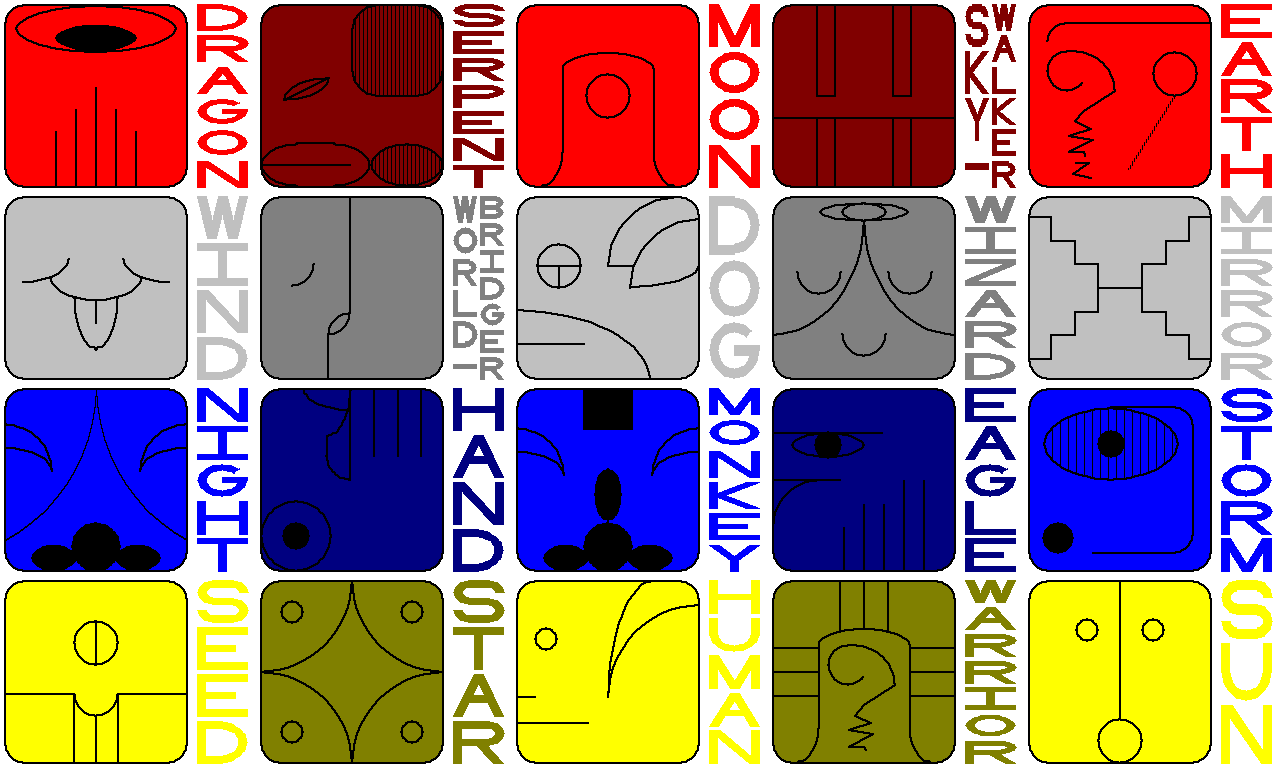
Image: The 20 seals in the Dreamspell calendar
Most calendar systems are based on the year, in which a solar year is divided into 12 months of 30-31 days on average. The Gregorian Calendar that originated in Europe, and is now used by much of the world, is organized like this. Similarly, the tropical zodiac is divided into 12 signs which are one month each.
In contrast to solar calendars, there also exist lunar calendars. A lunar synodic month (or length between one Full Moon and the next) is roughly 29.5 days. A calendar based on lunar phases would have 12.4 lunar months in a year, which is irregular but still more than 12. An alternative is to have 28 days or exactly four weeks in a month. That nicely results in exactly 13 months in a 364 day year, with one or two leap days to reach the average 365.24 days in a year.
The “13 Moon” calendar has been proposed as a replacement for the Gregorian Calendar or solar calendars in general. For example, the Dreamspell Mayan calendar popularized by José Argüelles is designed like this. The Moon and the number 13 have a feminine quality, and promoting this calendar over the Gregorian Calendar can be seen as helping promote feminine energies over outdated patriarchal structures. Lunar calendars are significant and a useful thing to consider, however it’s also important to see the bigger picture that encompasses both calendar systems.
  • Solar calendars are best for temperate regions near the poles. If you live in a temperate region, then the four seasons of three months each are a critical part of your experience and activities (such as planting, harvesting, preparing for winter, and so on). That means the position of the Sun or lack thereof is very important to timing, however the Moon plays little role because it’s often hidden behind stormy overcast skies for days at a time.
  • Lunar calendars are best for tropical regions near the equator. If you live on or near the equator, then you experience little in the way of seasons, and the good weather means you see the Moon virtually every night. In stories that take place in warmer regions, such as the classic novel “Island of the Blue Dolphins”, characters refer to events that happened “many Moons ago”, because months are very apparent while years mean little.
In summary, there’s no one correct calendar system. The right calendar to use depends upon the person or culture, along with their location in the world and what they’re trying to accomplish with it. Balance is needed, both with calendar systems and with gender issues in general. If an individual or group can understand both types of calendar system, and not fixate upon one while trying to suppress or replace the other, then they can make progress toward balancing the polarities within their own beings.
A visual image may be useful: A sphere contains both an equator and its two poles. The equator is a circle, which is more feminine in shape, and is associated with using the “feminine” polarity lunar calendar. The north and south poles form a rod penetrating through the center of the earth, which is more masculine in shape, and is associated with using the “masculine” polarity solar calendar. When both are present and working in harmony, we have a complete sphere, or unity and Oneness. :-) 

Saturday, January 24, 2015

The Four Levels of Perception

Picture credit: http://indrakrecere.deviantart.com/art/The-five-senses-254ff432088
Until we achieve an extremely high level of evolution, we each appear to exist as an independent being separate from other independent beings and the world surrounding ourselves. In other words, there’s a “self” and a “not-self”. The nature of perception (and even the very nature of consciousness itself) is energies that influence the self. These influences can be external impacts from the not-self upon the self, or they can be internal processings within the self. Below are four different levels upon which things can be externally perceived and internally processed:
Physical: senses (external) and urges (internal): The physical level means our bodies. On the physical level, a sense is a bodily perception of something external which impacts upon it. The classic five senses are touch, hearing, sight, taste, and smell. Some physical perceptions come from within the body, and include urges such as hunger, thirst, sleepiness, and so on. Physical pain often starts from an external impact, but continued pain afterward is internal discomfort.
Astral: emotions (internal) and feelings (external): The astral level means attractions and repulsions. An emotion is an internal reaction to a situation, which may manifest as a desire, aspiration, or result in an outburst of some form. The term “feeling” is rather general, and can be applied to everything from physical touch to spiritual intuition. In this context “feeling” is defined as a psychic reception. It’s easy to confuse emotions with true feelings. People sometimes call their emotions feelings, such as “I feel angry”. However, truly feeling anger is psychically picking up on anger outside yourself, which is actually quite rare. For example, one can use physical senses to pick up on somebody’s non-verbal expression, process that sense mentally and think that means they’re expressing anger, and then have an internal emotional reaction that perceives them as an opponent, but that’s different from directly sensing something astrally.
Mental: thoughts (internal) and receptions (external): The mental level means the level of intellect and the mind. Thoughts are intellectual processings and judgments within the head, analyzing ideas or memories within. As with the astral level, an external mental perception is rare, which we'll define using the word “reception”. A reception is telepathically picking up on an idea. Mental reception is rare because usually we use our physical senses to pick up on printed words (such as what you’re doing by reading this now :) and then mentally think thoughts and make judgments based upon them. Internal thoughts often turn into internal emotions when mental processings result in judgments, which create a positive or negative reaction. Mystics who prefer the richness of feelings to the dryness of thoughts have a important point, because a feeling is an external perception which brings in something new, while thoughts are just one’s internal processings which are frequently the same old tapes on autorepeat.
Intuitive (internal and external): Intuition is true spiritual perception, which takes place on a level beyond matter, emotion, and mind. Being spiritual, true intuition takes place on unified levels, so doesn’t really have external and internal forms. When intuition is contacted, we often label it as external channeling or internal knowing, but ultimately those are just labels for the same essential concept. Intuition can only be directly experienced, and therefore must be later reflected in mental thoughts, emotional feelings, or physical expression in order for us to record it or share it with others. We often label things as intuition that aren’t. For example, mental conclusions, psychic impressions, and even physical “gut feelings” are mental/emotional/physical perceptions on denser levels that sometimes get mistaken for true intuition.
Many situations take place on multiple levels. For example, sexual arousal is a physical internal state, but it often starts from being stimulated by external senses. It also involves non-physical perception, such as horniness being an internal emotional state of desiring sexual contact. Also, many perceptions result in others. For example, an emotional desire causes one to internally think about how they may satisfy it, which results in physical action. The reverse can happen too: Internal thinking may cause one to make a judgmental conclusion and have a positive or negative emotional response to it. Thoughts and emotions go back and forth so often and are so intertwined that eastern religions have a term for it: kama-manas or “desire-mind”. Being able to develop, identify, and refine our perceptions is an important part of character growth and eventually the spiritual Path.

Tuesday, November 18, 2014

Alpha, Beta, Gamma, & Delta - Choosing your role

Picture credit: http://www.deviantart.com/art/ALPHA-349964323
The “Alpha” is the leader or directing individual in a group. For example, the Alpha male and Alpha female wolves are the dominant pair in a pack. Alpha is actually one of several social roles or personalities which can be considered:
Alpha: An Alpha personality is a leader. The alpha is usually the strongest, which may be physical strength, personality strength, or even intellectual strength depending on the group or circumstances. Positively, Alphas are influential, good communicators, promote change, and are the keystone that holds a group together. Negatively, Alphas can be arrogant, controlling, and power hungry. They can create conflict by challenging others for leadership, or try to hold on to leadership even when others could do better. In politics, Alphas are the candidates running for office.
Beta:  A Beta personality is a follower. (Some sources refer to a Beta as the second in command, but either way the Beta is following.) Positively, Betas are humble, supportive, help allow a group to function smoothly. Negatively, Betas can be dependent, lazy, and expect others to do things for them or solve their problems. They can also be submissive and taken advantage of, or hide their own talents and abilities out of timidness. Alphas command attention, although if an Alpha is too needy in seeking things from others they’re really a type of Beta. In politics, Betas are the ones following or supporting a particular candidate or party (however if a Beta becomes a strong enough proponent to others about a philosophy, then they’re really a type of Alpha).
Gamma: The Gamma personality is independent. That means they neither try to control nor allow themselves to be controlled. Positively, Gammas are self-reliant, and necessarily productive because nobody’s taking care of them. Negatively, Gammas can be isolated, selfish, and don’t contribute anything to society because they’re self-absorbed. Some Gammas have the determination to become Alphas if they wanted to, but they don’t want to. In politics, Gammas are the ones saying things like, “Politics is annoying and corrupt, so I don’t pay attention to it.”
Above are the three main roles people play in a given context, presented in a rather general manner. Each role can be implemented positively or negatively. Also, an individual can play different roles in different contexts, such as an Alpha manager of a business who lives alone and so is a Gamma when outside of work. A classic saying (perhaps invented by somebody stuck in traffic) requests that people should “lead, follow, or get out of the way” which is a summary of the three roles. Are there any roles other than Alpha, Beta, and Gamma? For example, consider a “group of equals”. However, such a group still has Alphas, because they are the ones that ensure the group of equals runs smoothly, or are the ones proposing and promoting ideas within the group for others to follow. There is however a meta-role to consider, which is a positive way of approaching Alpha, Beta, and Gamma:
Delta: The Delta personality is dynamic. The Greek letter Delta is a triangle, which is appropriate since it covers the three roles above synthesized and integrated. A Delta is confident and capable enough to lead, complete within themselves and humble enough that they’re not threatened by following, they’re self-reliant enough to be independent, and most importantly adaptable enough to switch between these roles as needed. If there’s an ideal role it’s Delta, because the person isn’t just focused on themselves and what they want to do, but are considering what’s needed for the good of the whole. The only potential downside is if a Delta focuses too much on serving others in whatever role that they neglect their own needs or inspirations, in which case they’re really a less positive type of Beta.

Wednesday, August 27, 2014

Meditation - Spiritual Exercise


Most people recognize the value of physical exercise, and can see how it improves strength and other physical attributes. Some people recognize that the mind can be exercised, and that intelligence can also be increased with practice. (Genetics plays a role in intelligence, just as it does physically, but a body or mind unused will go soft.) One final area is spirituality, which relatively few people (at this time) see the value in developing. Spiritual qualities like compassion and intuition can be increased, if we’re willing to exercise them.

One of the main forms of spiritual exercise is meditation. The simplest form of meditation is a sustained concentration upon a particular subject. In typical meditation, one focuses on a particular object or concept, considering and contemplating all its facets. That exercises one’s ability to stay focused and avoid external distractions, which is useful in today’s internet age. ;) Meditation can also be done as a group, which can be a powerful way to connect and work together.

Too often our lives are overfilled with physical activity, emotional reactions, and mental chatter, leaving little room for spiritual consideration. In other words, we sometimes let ourselves be dragged through life by bodily urges, emotional turmoil, and random ideas, instead of consciously and mindfully living life. Meditation allows more subtle vibrations to be sensed, like leaving the light pollution of a noisy city to be able to notice and experience the stars in the serenity of nature. This state of being can be called imagination, intuition, hearing the inner voice, and many other names.

One might think that those who meditate aren't accomplishing anything useful. That’s technically true, but only in a mundane sense. Inactivity on a physical level can mean one is more active on deeper spiritual planes, which have great opportunities for service. Which is more productive and meaningful: Physically earning a million dollars, or energetically building respectful understanding between people and nations?

We inhabit physical bodies, and the body is a wonderful tool, but we are not our bodies. That can be seen and proven after physical death, after which we exist much as before, but without physical pains and so on impinging upon our consciousness. Similarly, although we experience emotions and even thoughts like watching a movie, we are not our reactions and interpretations. Being aware of our core spark of conscious awareness allows us to better use and integrate our body, feelings, and thoughts.

Meditation, like physical exercise, can be done incorrectly or excessively. Aligning with the spiritual shouldn't mean abandoning or disliking the physical. Proper meditation is about actively tuning in and focusing, not passively tuning out and disconnecting from the world. The balance of bringing spiritual inspiration into a productive physical life is nicely covered in the classic adage based on Matthew 4:4, “One cannot live by bread alone, but neither can one live without bread.”

My book “Evolution of the Spirit: Our Journey Through the Universe” contains more information about meditation, in chapter 13 “Spiritual Practices”. ♥

Tuesday, July 22, 2014

Discrimination - Capacity for Choice

Prism by Jessy McBump
Picture credit: http://jessymcbump.deviantart.com/art/Prism-362050162

Discrimination is the faculty of mind to perceive differences, and is what allows us to make informed decisions in life. Like many tools, it can be employed usefully or badly misused.

Some see “discrimination” as a dirty word, associating it with sexism, racism, classism, and other "isms". Indeed, negative discrimination is the cause of these problems, however real discrimination is a much deeper concept. More generally, discrimination is interpretation. Our outer or inner senses perceive something, and our mind interprets it as true or untrue, good or bad, pleasurable or annoying, and so on. These classifications may be accurate, biased, selfish, or any number of other qualities, but almost everybody is continually making them.

Discrimination is based on the Latin word for separate. We are all One, although in our manifest world this Oneness is expressed in many diverse ways, like the unity of white light refracted into a rainbow. In the grand scheme of things, separation allows us to ground and perceive different aspects of infinity. For example, different color paints are kept separate, else they would blend into an ugly uniform gray. In the human body, blood in the veins needs to be kept separate from air in the lungs. Both are needed for physical life, but blood in the lungs or air in the bloodsteam quickly results in death. However, problems arise when things become separated too much, or we forget we’re inherently One.

Discrimination is a tool: It takes practice to learn to use it properly and accurately. Undeveloped discrimination can be when it isn’t employed enough. For example, not recognizing a scam, or not realizing that one’s in an abusive relationship. Undeveloped discrimination can also be it overgeneralized or taken to extremes. For example, having an ex-romantic partner who was an Aries, and therefore thinking that all Aries people are jerks. Or even preferring strawberry ice-cream over other flavors, and thinking that everybody who doesn’t also know the truth that strawberry ice-cream is better than all others must die in a holy crusade of cleansing fire! ;)

Proper discrimination allows us (and penguins) to find our soulmates among millions of possible partners. It allows me to me able to determine which keys to press next while typing this sentence. It allows us to decide what to do with our time on this planet, and how we can most efficiently grow ourselves and serve others.

In summary, discrimination and its development is part of being human. Plants grow and bend toward the sun, but do so automatically or instinctually, without a mind interpreting and deciding to do so. Discrimination is also different from intuition. True intuition is beyond thought and duality. Intuition can bring in spiritual energy, however once it reaches our minds it’s up to developed discrimination to perceive and maintain the energy, and translate it into proper choices in our world.

Today let’s recognize the ways in which discrimination manifests in our lives, and work to refine the ways in which we use it. ♥